

 Communication, Business Process

BCU, a not-for-profit, member-owned credit union, had a service desk that wasn’t struggling with a lack of expertise. Rather, it was struggling with administration.
Every support call required technicians to solve the issue, document the interaction, create a ticket, and ensure the right information made it into the system. For a four-person service desk supporting a growing organization, that manual work was adding up.
After partnering with Cloud Revolution to automate ticket creation and standardize information capture, BCU reduced total effort per support interaction by 29%, lowered costs from $38 to $27 per call, and now saves approximately $1,100 every week.
What began as an initiative to improve call handling has since become the foundation for broader service desk automation across the organization.
The Challenge: Too Much Time Spent Managing Tickets
Before engaging Cloud Revolution, BCU was looking for ways to streamline the information flowing into its service desk and create greater consistency across support interactions.
Every support call was different. Every technician had their own note-taking style. And when service desk volumes increased, ticket creation could sometimes lag behind the actual customer interaction.
As Service Desk Team Lead, Steve McKinney, explains:
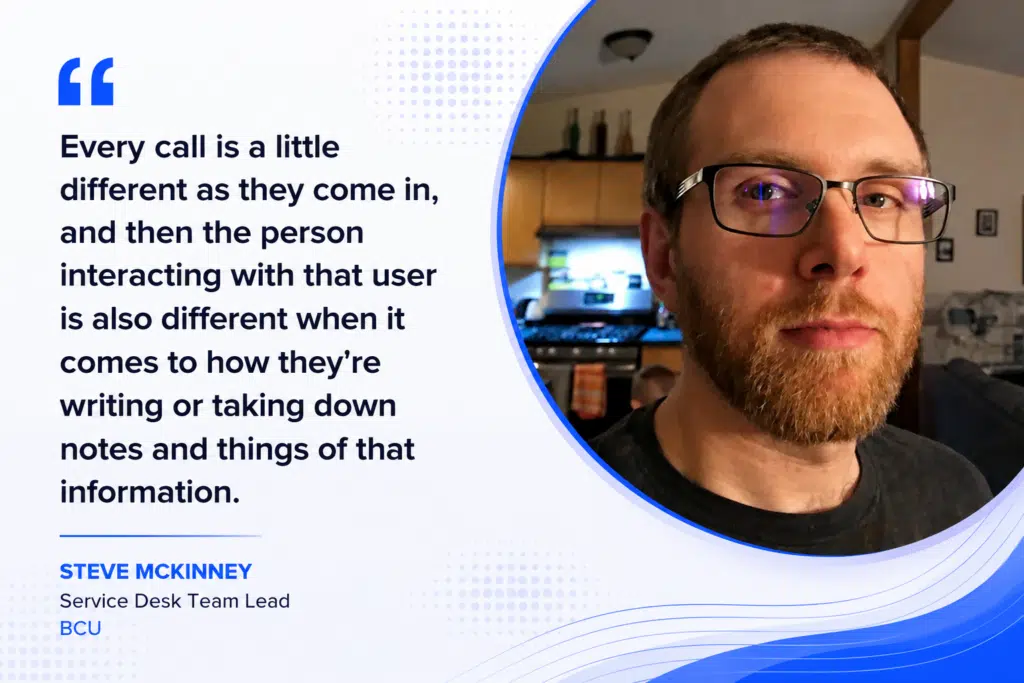
“Every call is a little different as they come in, and then the person interacting with that user is also different when it comes to how they’re writing or taking down notes and things of that information.”
With a relatively small service desk team, outages, staff absences, or unexpected spikes in demand could create additional pressure on technicians.
“If someone goes down or they’re out on vacation, or we’ve got an outage, it’s very easy to get slammed and then you lose sight and focus of those calls coming in.”
The team wanted to improve consistency, reduce handling times, and remove administrative work wherever possible.
The Solution: Automating Ticket Creation and Standardizing Information Capture
Working with Cloud Revolution, BCU implemented an automated call-routing and ticket-creation workflow designed to capture information immediately and remove manual processes from the service desk experience.
When users contact the service desk, the system automatically collects key information, including:
- User details
- Environment information
- Location context
- Initial issue descriptions
That information is then automatically passed into BCU’s ticketing system, creating an immediate record of the interaction.
Instead of spending valuable time manually creating tickets after a call, technicians can begin working directly from information that has already been captured and structured.
The project then evolved beyond simple ticket creation.
BCU combined the workflow with Microsoft Copilot-powered processes that help standardize ticket documentation and troubleshooting records across the service desk.
This ensures that information is captured consistently regardless of which technician handles the interaction.
As McKinney explained:
“We’re also getting more similar information entered into the ticketing system.”
The result is a support process that is more structured, predictable, and easier to analyze.
The Results: 29% Less Effort Per Support Interaction
The biggest benefit has been the reduction in time spent handling and documenting support requests.
Before the implementation, BCU technicians spent an average of 14 minutes on every support interaction. Around 10 minutes were spent troubleshooting issues, with a further 4 minutes dedicated to ticket administration.
Today, the average troubleshooting call takes 8 minutes, while administrative work has been cut to 2 minutes, reducing total effort per interaction to 10 minutes.
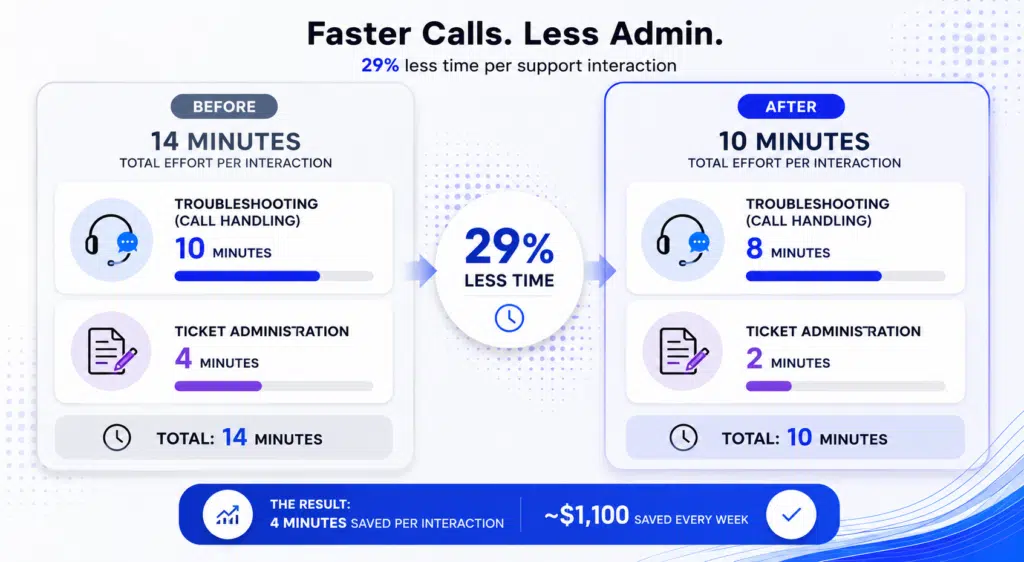
A view of the metrics
| Metric | Before | After |
| Call handling time | 10 mins | 8 mins |
| Ticket administration | 4 mins | 2 mins |
| Total effort per call | 14 mins | 10 mins |
| Cost per call | $38 | $27 |
| Weekly savings | — | $1,100 |
Overall, BCU has reduced the total effort required for each service desk interaction by approximately 29%.
The impact extends beyond time savings. By lowering the average cost per interaction from $38 to $27, the service desk now saves approximately $1,100 every week — equivalent to more than $57,000 annually.
Just as importantly, the quality of the data entering the system has improved.
By combining automated ticket creation with Copilot-assisted transcription and documentation workflows, BCU now captures information in a standardized format across all technicians. This consistency provides better reporting, greater visibility, and a stronger foundation for future automation initiatives.
Eliminating the Risk of Lost Requests
For BCU, the value of the project extends beyond time savings.
Automatic ticket creation has significantly improved visibility across the service desk.
Every interaction is automatically logged as a ticket, giving the team a clear record of incoming requests and ensuring calls are tracked from the moment users enter the support workflow.
“This has enabled us to ensure that we’re not missing those calls,” said McKinney. “Even if a call doesn’t go answered, a ticket’s automatically created.”
The change has removed a major administrative burden from technicians.
Instead of worrying about documenting information after a busy period, they can focus on resolving issues while the system handles the intake process.
“It takes away a stress point from the service desk,” McKinney added. “They can focus more on the work of what they need to do.”
For a lean support team, that means less time chasing information and more time helping users.
A Foundation for Future Automation
What started as an initiative to improve call handling has created new opportunities for automation across BCU’s support environment.
The service desk team is already exploring additional self-service capabilities, AI-powered support workflows, and deeper integrations between its knowledge management and ticketing systems.
The organization has even begun expanding its internal AI ecosystem through projects like its “Miss Clippy” assistant, which helps users access support resources and status information through a conversational interface.

For BCU, the project delivered more than improved efficiency.
It created a platform for continuous improvement.
As Service Desk Level 2 Technician, Rico Feliciano, explains:
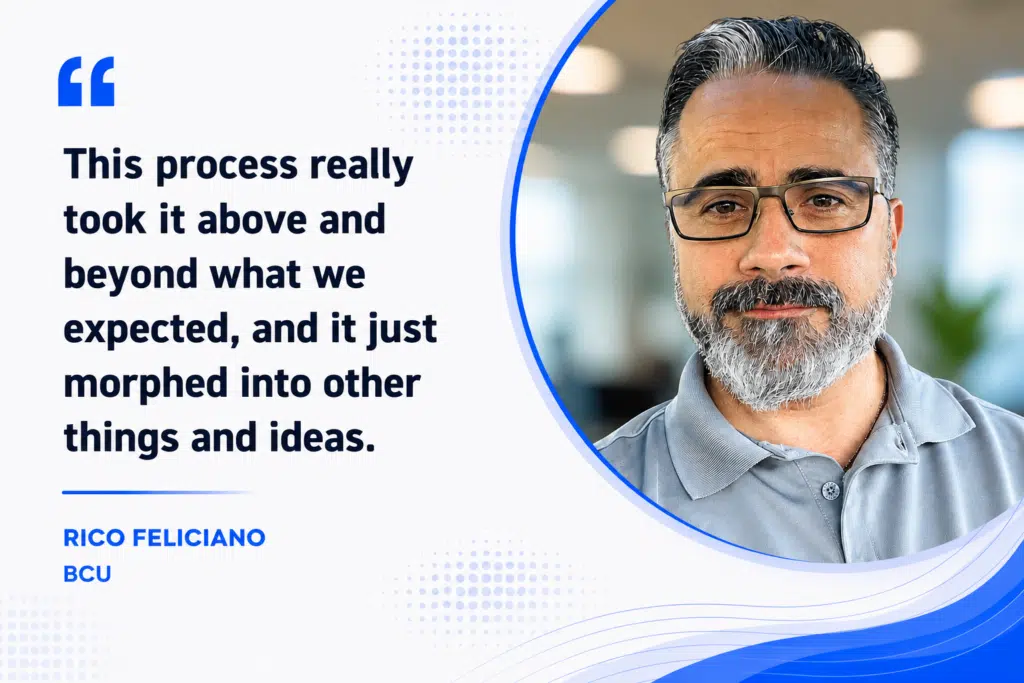
“This process really took it above and beyond what we expected, and it just morphed into other things and ideas.”
By automating ticket creation, standardizing information capture, and reducing administrative overhead, BCU has built a more efficient service desk today while creating a foundation for even greater automation tomorrow.
Modernize with Confidence
BCU reduced service desk effort by 29% and saves more than $57,000 annually by automating ticket creation and standardizing support workflows.
Cloud Revolution helps organizations achieve similar outcomes through Microsoft-aligned communications, AI, and automation solutions.
As a Microsoft Partner of the Year winner, Cloud Revolution delivers the proven expertise, structured delivery, and Microsoft-backed approach that IT leaders trust when modernizing critical systems.
?Talk to Cloud Revolution about your modernization roadmap today.
You must be logged in to post a comment.