

 Business Process

Moving to Microsoft Teams Phone sounds straightforward.
Until you start asking questions.
Can you keep your existing phone numbers?
Should you choose Operator Connect or Direct Routing?
What happens to call recording, analog devices, or emergency calling?
By the time you’ve answered those questions, you quickly realize a Teams Phone migration isn’t just about replacing your phone system.
It’s about making dozens of technical and business decisions that will affect your organization for years to come.
Some are easy to change later.
Others aren’t.
That’s why Microsoft Teams voice consulting isn’t about deploying Teams Phone.
It’s about helping you make the right decisions before your migration begins.
In this guide, you’ll learn what Microsoft Teams voice consulting services actually include, when specialist expertise adds value, and how to avoid the mistakes that make voice projects more expensive and more complicated than they need to be.
Whether you’re replacing a legacy PBX, planning an international rollout, or building a business case for Teams Phone, this guide will help you move forward with confidence.
What Are Microsoft Teams Voice Consulting Services?
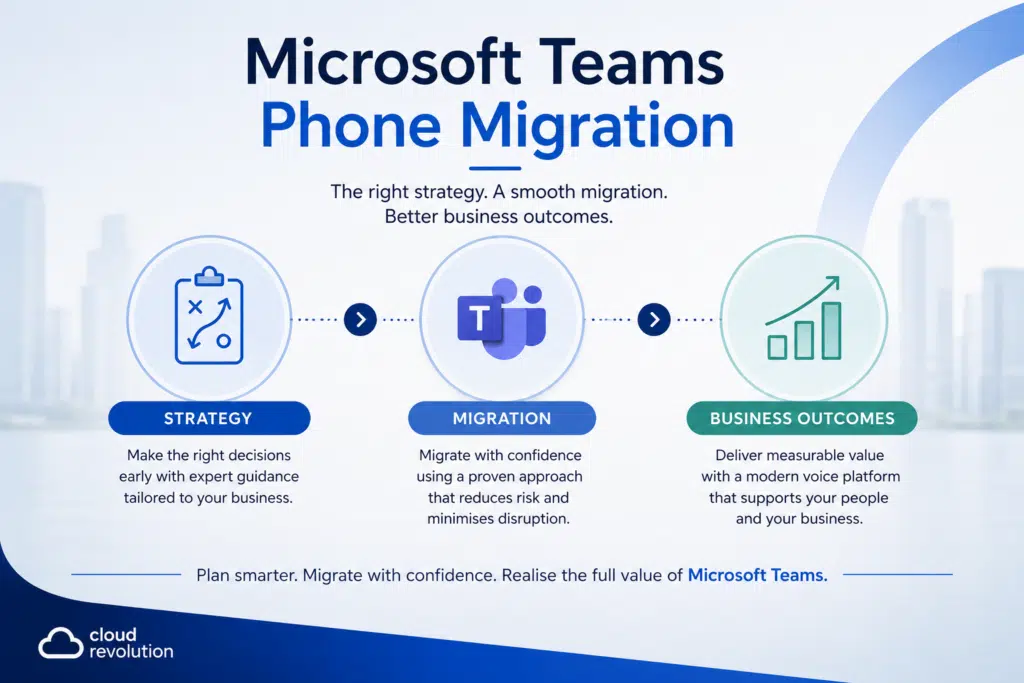
Microsoft Teams voice consulting helps you replace, modernize, and optimize your business phone system using Microsoft Teams.
That might sound simple.
In reality, a successful voice project depends on dozens of decisions that happen long before the first user makes a call.
Should you migrate your existing phone numbers?
Which voice connectivity option is right for your business?
How will Teams Phone work alongside your contact center, compliance requirements, and existing devices?
Those aren’t implementation tasks.
They’re business decisions that influence the success of your entire project.
That’s where Microsoft Teams voice consulting adds value.
Instead of starting with products or licenses, a good consultant starts by understanding how your business communicates today and what you need it to look like tomorrow.
From there, they help you design a voice strategy that fits your organization.
That could include:
- Choosing the right Teams Phone architecture
- Planning your migration from a legacy PBX
- Supporting compliance, user adoption, and long-term growth
The result isn’t just a successful Teams Phone deployment.
It’s a voice platform that’s easier to manage, easier to scale, and better aligned with the way your business works.
Why Microsoft Teams Voice Projects Are Different
Deploying Microsoft Teams is one thing. People can adapt to a new collaboration tool over time.
Replacing your business phone system is another. They won’t accept missed customer calls, unavailable phone numbers, or a voice service they can’t rely on.
That’s why Microsoft Teams Phone projects involve decisions that most Microsoft deployments don’t.
For example, you may need to decide:
- Whether Operator Connect or Direct Routing is the right fit for your organization
- How you’ll migrate existing phone numbers without disrupting the business
- What happens to compliance recording, emergency calling, and analog devices
Each decision influences the next.
Your choice of voice architecture affects your migration strategy.
Your migration strategy affects the user experience.
The user experience determines whether your Teams Phone rollout is remembered as a success or a disruption.
That’s why the best Microsoft Teams voice consulting starts before the first number is ported.
A good consulting partner helps you answer the difficult questions early, so your migration is simpler, lower risk, and easier to manage from day one.
Planning your voice strategy before deployment also gives you the flexibility to scale, support new locations, and adopt future Microsoft innovations without redesigning your telephony environment.
The goal isn’t simply to replace your PBX.
It’s to build a voice platform your business can rely on for years to come.
When Does Microsoft Teams Voice Consulting Add Value?
Not every organization needs specialist voice consulting.
If you’re replacing a small phone system with straightforward requirements, an experienced internal IT team or Microsoft partner may be all you need.
The value of Microsoft Teams voice consulting increases as the cost of getting a decision wrong increases.
For example, specialist expertise is often worthwhile if you’re:
- Replacing a legacy PBX used across multiple offices or countries
- Migrating hundreds or thousands of users to Microsoft Teams Phone
- Supporting business-critical services that can’t afford disruption
In these situations, the cost of poor planning is usually far greater than the cost of expert advice.
A delayed number port can impact customer service.
The wrong voice architecture can limit your options later.
Unexpected compatibility issues can delay your migration and increase project costs.
That’s why many organizations bring in a Microsoft Teams voice consultant before making major technical decisions.
The objective isn’t simply to reduce project risk.
It’s to make informed decisions that continue delivering value long after your migration is complete.
What Should Microsoft Teams Voice Consulting Include?
The best Microsoft Teams voice consultants don’t start by recommending technology.
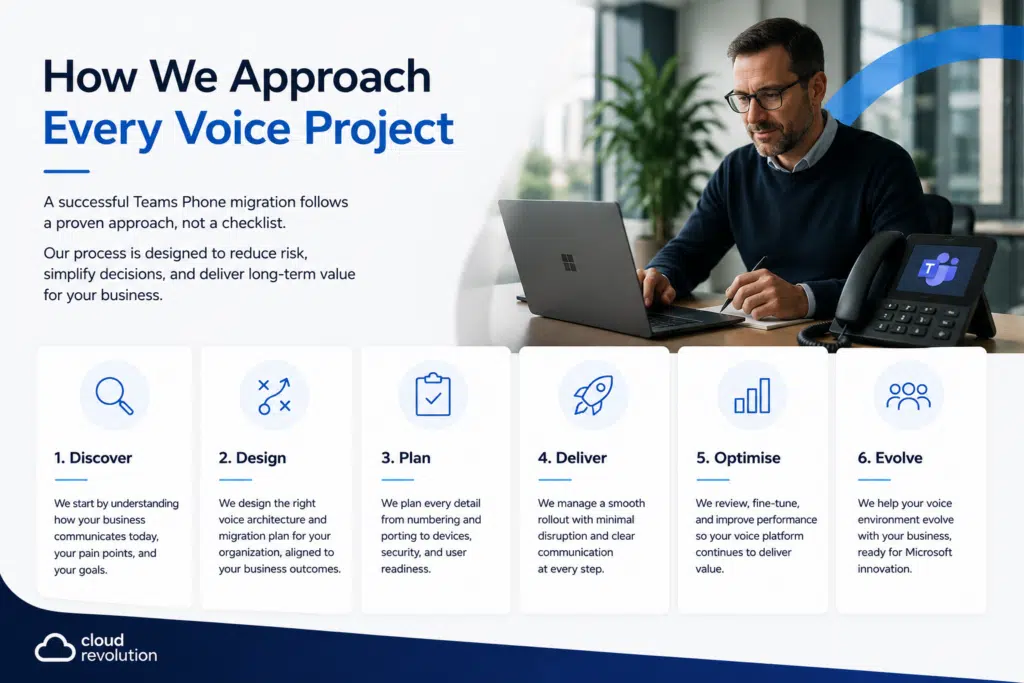
They start by understanding how your business communicates today, where the risks are, and what success needs to look like after your migration.
Only then should they recommend the right architecture, migration approach, and supporting services.
That’s important because no two organizations have the same voice requirements.
A solution that’s right for one business may introduce unnecessary cost or complexity for another.
Use the table below as a checklist when comparing Microsoft Teams voice consulting providers.
| Consulting area | What you should expect |
| Voice Strategy | A migration roadmap built around your business objectives, not just your technical requirements. |
| Voice Architecture | Independent guidance on Operator Connect, Direct Routing, Microsoft Calling Plans, and the approach that best fits your organization. |
| Migration Planning | A structured rollout covering number porting, cutover planning, business continuity, and user communications. |
| Devices & Compatibility | Support for Teams-certified devices, analog devices, meeting rooms, and any business-critical hardware that needs to remain in service. |
| Compliance & Security | Emergency calling, compliance recording, retention, and regulatory requirements considered from the start, not added later. |
| User Readiness | A practical adoption plan that gives employees confidence in the new phone system from day one. |
| Optimization | Ongoing reviews and recommendations that help your Teams Phone environment continue delivering value as your business evolves. |
A successful Teams Phone migration isn’t defined by how quickly the technology is deployed.
It’s defined by how well the decisions made before deployment continue to support your business months and years later.
That’s why good Microsoft Teams voice consulting focuses on outcomes first and technology second.
How Much Do Microsoft Teams Voice Consulting Services Cost?
The honest answer is: it depends on the complexity of your voice environment.
Migrating a single office with straightforward calling requirements is very different from replacing an international PBX, consolidating multiple carriers, or rolling out Microsoft Teams Phone across hundreds of users.
As a guide, you can typically expect the following.
| Project type | Typical consulting investment |
| Voice assessment or discovery workshop | $2,500–$10,000 |
| Microsoft Teams Phone migration | $10,000–$50,000+ |
| Multi-site voice transformation | $25,000–$100,000+ |
| Enterprise telephony modernization | $100,000+ |
| Ongoing voice optimization and managed services | Monthly retainer based on users and scope |
These figures are intended as a guide.
The final investment depends on factors such as:
- The number of users, sites, and countries involved
- Your existing telephony environment and carrier contracts
- The level of migration planning, user readiness, and post-go-live support required
The more important question isn’t what Microsoft Teams voice consulting costs.
It’s what poor planning could cost your business.
Unexpected delays, failed number ports, avoidable downtime, or choosing the wrong voice architecture can all increase the cost of your migration long after the project has gone live.
That’s why the best Microsoft Teams voice consulting focuses on helping you make informed decisions before your migration begins.
A well-planned project doesn’t just reduce delivery risk.
It creates a voice platform that’s easier to manage, simpler to scale, and delivers long-term value from your Microsoft investment.
The Decisions That Cost Organizations the Most
Not every Teams Phone migration runs into problems.
But when they do, the cause is rarely Microsoft Teams itself.
It’s usually one decision made early in the project that creates unnecessary complexity later.
For example…
| Decision | The long-term impact |
| Choosing a voice architecture before understanding business requirements | Limits flexibility and can increase migration costs later. |
| Treating Teams Phone as a like-for-like PBX replacement | Misses opportunities to simplify communications and reduce costs. |
| Leaving number porting until the end of the project | Increases the risk of delays and disruption during cutover. |
| Designing around today’s requirements | Creates unnecessary work as your business grows or changes. |
| Measuring success by go-live | Ignores user adoption, business value, and long-term optimization. |
None of these are technology problems.
They’re planning decisions.
That’s why the best Microsoft Teams voice consulting happens before technical work begins.
What Does a Successful Teams Phone Migration Look Like?
A successful Microsoft Teams Phone migration isn’t measured by how quickly the last number is ported.
It’s measured by what your business looks like six months later.
By then, your phone system should feel like part of Microsoft Teams, not another platform your IT team has to manage.
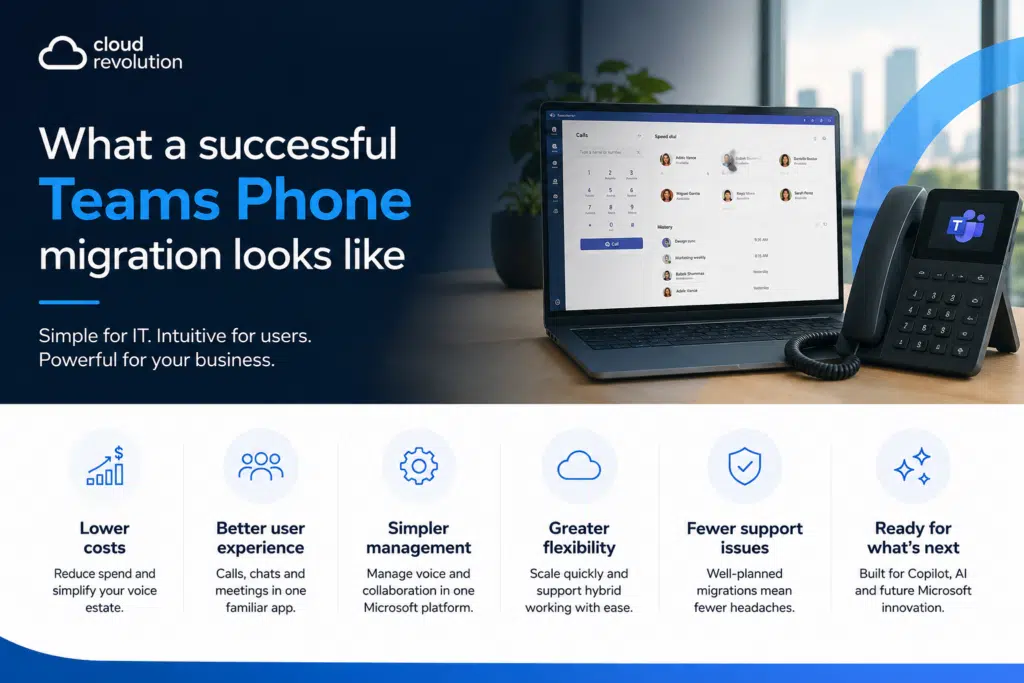
Here’s what success typically looks like.
| Outcome | What it means for your business |
| Lower telephony costs | Fewer contracts, reduced infrastructure costs, and a simpler voice estate. |
| A better user experience | Employees make and receive calls confidently from the Teams app they already use every day. |
| Simpler management | Voice, collaboration, and administration are managed through a single Microsoft platform wherever possible. |
| Greater flexibility | Adding users, opening new locations, or supporting hybrid working becomes significantly easier. |
| Fewer support issues | A well-planned migration reduces common voice problems and gives IT fewer reactive issues to deal with. |
| A platform ready for the future | Your voice environment can support Microsoft Copilot, AI-powered communications, and future Microsoft innovation without another major redesign. |
A successful migration doesn’t end when your legacy phone system is switched off.
It ends when your users stop thinking about the technology altogether.
Calls simply work.
Employees know how to use the platform.
Your IT team spends less time managing telephony and more time delivering value elsewhere.
Those are the outcomes Microsoft Teams voice consulting should help you achieve.
Microsoft Teams Voice Consulting in Action
The best way to evaluate a Microsoft Teams voice consulting partner isn’t by the services they offer.
It’s by the outcomes they’ve delivered.
Below are a few examples of how we’ve helped organizations solve different communications challenges using Microsoft technologies.
| Challenge | Outcome | Case study |
| Replace Zoom with Microsoft Teams while minimizing disruption to employees and maintaining productivity. | Delivered a structured migration strategy that simplified collaboration, reduced disruption, and helped users transition with confidence. | https://www.cloudrevolution.com/zoom-to-microsoft-teams-migration/ |
| Improve Microsoft Copilot adoption after the initial rollout failed to deliver the expected value. | Delivered practical coaching that increased confidence, improved adoption, and helped employees get more value from Microsoft 365. | https://www.cloudrevolution.com/copilot-coaching/ |
| Reduce the time spent creating and managing IT service tickets manually. | Used Microsoft technologies to streamline workflows, reduce manual effort, and improve operational efficiency. | https://www.cloudrevolution.com/reduce-manual-ticket-creation/ |
| Build a business case for Microsoft Teams Phone before committing to a migration. | Demonstrated potential cost savings, operational improvements, and return on investment, giving leadership the confidence to move forward. | https://www.cloudrevolution.com/teams-phone-roi/ |
Looking for Microsoft Teams Voice Consulting?
If you’ve reached this point, you’re already asking the right questions.
The next step is finding a consulting partner that can help you answer them.
Whether you’re replacing a legacy PBX, planning a Microsoft Teams Phone migration, or reviewing your voice strategy, the right advice early in the project can reduce risk, simplify delivery, and help you avoid expensive decisions later.
Our Microsoft Teams Voice Consulting service is designed for organizations that want to build the right voice platform, not just complete another migration.
You’ll get practical guidance from Microsoft specialists who have helped organizations modernize communications for millions of users, with a focus on business outcomes rather than simply deploying technology.
Explore Microsoft Teams Voice Consulting Services
Learn how Cloud Revolution helps organizations plan, migrate, and optimize Microsoft Teams Phone with confidence.
→ View Microsoft Teams Voice Consulting Services
You must be logged in to post a comment.